How do we escape the brain-melting effects of hot weather? In affluent countries, many of us cope with the heat by cranking up the AC. But as we know too well, AC is also a major source of emissions, speeding up climate change even more.
Air conditioning: A vicious cycle
Even at the best of times, we’re not great at prioritizing our future selves. When it’s hot outside and we become angry and irritable, we become even more prone to hyperbolic discounting, which causes us to place more value on immediate gains than we do on larger, long-term ones. Thus, when we crank up the AC, we perpetuate the air conditioning paradox.
But our reliance on AC is paradoxical in more ways than one. At the same time that AC is helping to make the planet hotter, it’s also reducing our psychological tolerance for said heat. The “adaptive comfort model” outlines how, the more accustomed we become to a certain standard of comfort, the more unbearable the outdoor heat feels to us.1,2
AC saves lives
It’s important to note that AC is not just a luxury. In pre-industrial times, heatwaves brought with them mass death and illness, and even today, people who don’t have access to cooling are still at risk of serious health problems during hot stretches.
Still, AC presents a big challenge for our human brains. Most of us are all but guaranteed to choose immediate relief from the heat over the prospect of a slightly cooler future, even on days when we would really be okay without AC.
Eco-anxiety further clouds decision-making
While previous generations ran the risk of mass deaths from heat waves, they didn’t have to worry about eco-anxiety, defined as enduring concerns about our planet and the future of the environment.3 Eco-anxiety has significant impacts on our mental wellbeing,4 especially among younger populations.5 In fact, a poll conducted in 2020 revealed that 70% of people aged 18-24 were more anxious about climate change than they were a year ago.6
Like anger, this anxiety influences our decision-making. It increases the chances that ambiguous choices will be interpreted as negative and causes us to avoid potentially negative outcomes, even if that means avoiding potentially positive ones.7 In this avoidance of potentially negative outcomes, an anxious person may also rely on the status quo bias, meaning they would prefer to stick with what’s familiar and comforting rather than changing the status quo by picking something new.8 Among other things, that means turning on the AC and going about business as usual.
While heat can trigger anger, eco-anxiety can trigger a line of thinking that hinders us from altering our course of action — for example, choosing more eco-friendly products at a store or using AC less frequently. Notably, these behaviors are seen around the world and will become more prevalent in the coming years.
The world is poised to see many more AC units in the near future
Countries that experience incredibly hot temperatures, including India, Indonesia and Brazil, also have fast-growing economies.9 This means that billions of people in the Global South will soon be able to afford their first air conditioning units.
The UN estimates that there are 3.6 billion cooling units (appliances that cool buildings, food, medicine, etc) being used today, and that number is expected to jump to 9.5 billion by 2050.10 While this is good news for those who don’t have the resources to survive intense heat waves, it will also mean that there will be even more pollutants into our atmosphere. In the short term, expanded access to cooling will likely save many lives — but it will also massively increase pollution from air conditioning, underscoring the need to find sustainable alternatives fast.


behavior change 101
Refrigerants, though damaging to the environment, are nearly omnipresent
As air conditioning units are used, they slowly leak hydrofluorocarbon (HFC) refrigerants (the type of refrigerant used in most air conditioners) into the atmosphere.11 HFCs are roughly 1,000 - 3,000 times more potent than CO2.11 According to calculations by the World Economic Forum,12 greenhouse gas emissions created by AC will account for as much as a 0.5 degree C increase in global temperatures by the end of the century.11
Since Willis Carrier invented the first modern cooling system in 1902, cooling technology like air conditioning has worked its way into nearly every facet of modern life.13 As a result, it’s nearly unthinkable to consider removing or altering them, even if the benefit is the very real possibility of preventing a climate catastrophe.

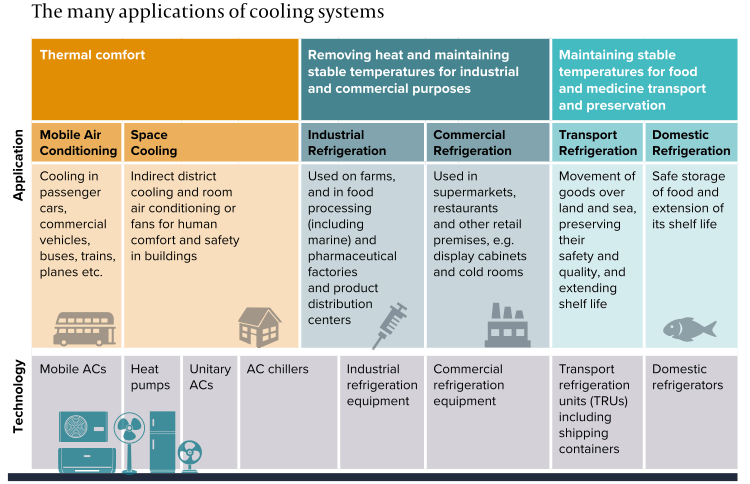
From "Cooling Emissions and Policy Synthesis Report" (UNEP, 2020)
Is there any hope for the future?
With that kind of heat, air conditioners could run the risk of breaking down. Given that they work by displacing the heat inside your house onto the outdoors, if it’s too hot outside, there will be nowhere for that heat to go.14
We are at a unique moment in human history: do we continue to do what we’ve done, risking greater environmental and emotional devastation in the future? Or do we advocate for and adopt different ways of cooling down, such as responsible building materials and water evaporation technology,15 in lieu of an increase in AC usage?
Here are some actionable steps that you can take to dial back your AC usage, and to manage tough climate-related emotions.
Using AC less frequently
If you are able, try to allow your indoor environment to reach a higher temperature, say up from 69ºF to 72ºF.2 You could also try shading your windows during the hottest parts of the day in order to prevent sunlight from heating up your space.
Lastly, if you will be out of the space for a while, try allowing the indoor temperature to rise by turning off the AC, then turning it back on when you return.
Mitigating eco-anxiety
When we feel anxious about the environment, it’s easy to fall into the cognitive trap of feeling helpless. What do we do? Firstly, recognize that you’re not alone — many people are experiencing eco-anxiety all across the world. Since this is a global phenomenon, try reading up on good news - what people are doing in different countries to tackle these issues. Doing this will help you stay optimistic and encourage you to make decisions that are distinct from your status quo.
Getting involved with environmentally-conscious organizations can serve as an antidote to eco-anxiety.16 In doing this, you will build relationships with others - a key building block of resilience,17 and will also create a stronger relationship with nature.18
You can be a catalyst for change, even at a small scale
When it starts to get hot outside, we are faced with a range of emotions, primarily a desire for relief from the heat and anxiety about the environment. Given cooling systems are so ingrained in our societies, they are likely to remain for a while. However, learning about how to reduce your AC usage and your eco-anxiety can improve your mental wellbeing. Engaging in these actions and having these conversations can also build momentum for a large-scale change in how we talk about and use harmful refrigerants, with the hope of building a more sustainable future for generations to come.