Why do we focus on items or information that are more prominent and ignore those that are not?

The 

Salience Bias

, explained.
Bias

What is the Salience Bias?

The salience bias refers to our tendency to focus on information that stands out, whether due to its prominence, emotional impact, or vividness, often at the expense of other less noticeable or less emotionally charged details.
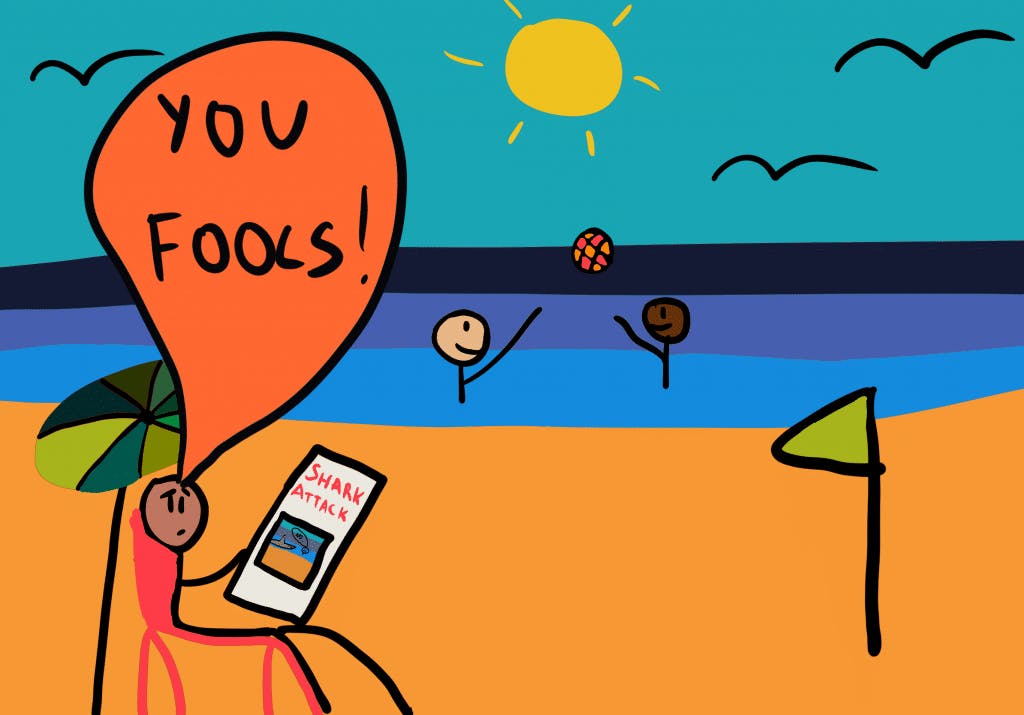
The image depicts a beach scene where a person sitting under an umbrella is reading a newspaper with the headline "Shark Attack." The person has a large speech bubble above their head saying "YOU FOOLS!" In the background, two other figures are happily playing in the ocean, seemingly unaware of the warning.

Where this bias occurs

If you watch the news and see multiple reports of violence in your city, you might start feeling like it's becoming more dangerous. Even if crime rates haven’t actually increased and your chances of victimization haven’t changed, those stories stick in your mind. As a result, you feel more uneasy when leaving your home, even though the overall risk remains the same. This is an example of salience bias—when recent or vivid events shape your perception more than the actual data.

The more visible or dramatic an event is, the more weight your brain assigns to it. This can make the event or problem seem more common than it actually is. Media coverage often plays a significant role in amplifying this bias. For example, continuous reporting on violent crime can give the illusion that the problem is omnipresent when, in fact, overall crime rates are declining. 

The salience bias has been applied to various fields, including marketing, public policy, and finance. Behavioral scientists, for example, use salience bias to design nudges that encourage better choices, like displaying graphic warnings on cigarette packaging to make health risks more apparent.

Sources


  1. Armenia, G. (2013). Lazy Thinking: How Cognitive Easing Affects the Decision Making Process of Business Professionals. Honors College Theses. 126. https://digitalcommons.pace.edu/honorscollege_theses/126.
  2. Verena et al. (2018). Overcoming Salience Bias: How Real-Time Feedback Fosters Resource Conservation. Management Science, 64(3), 1458-1476.
  3. Ibid.
  4. Bollinger et al. (2010). Calorie posting in chain restaurants. National Bureau of Economic Research.
  5. Milkman, K. L., Rogers, T., & Bazerman, M. H. (2008). Harnessing Our Inner Angels and Demons: What We Have Learned About Want/Should Conflicts and How That Knowledge Can Help Us Reduce Short-Sighted Decision Making. Perspectives on Psychological Science, 3(4), 324–338. https://doi.org/10.1111/j.1745-6924.2008.00083.x
  6. Taylor, S. E., & Fiske, S. T. (1975). Point of view and perceptions of causality. Journal of Personality and Social Psychology, 32(3), 439–445. https://doi.org/10.1037/h0077095
  7. Schenk, D. H. (2011). Exploiting the Salience Bias in Designing Taxes, 28 Yale J. https://digitalcommons.law.yale.edu/yjreg/vol28/iss2/2.
  8. Kehr, F. (2016). Feeling and thinking: On the role of intuitive processes in shaping decisions about privacy (Doctoral dissertation, Universität St. Gallen).
  9. Allcott, H. and Wozny, N. (2014). Gasoline Prices, Fuel Economy, and the Energy Paradox, The Review of Economics and Statistics, 96, issue 5, 779-795. https://EconPapers.repec.org/RePEc:tpr:restat:v:96:y:2014:i:5:p:779-795.
  10. Puckett, J. (2025, February 20). ​​Are Plane Crashes Actually Happening More Frequently? Condé Nast Traveler. https://www.cntraveler.com/story/are-plane-crashes-actually-happening-more-frequently
  11. OCHA. (2015).Humanitarian concerns in the post-2015 development agenda. OCHA. https://www.un.org/en/ecosoc/qcpr/pdf/HumanitarianConcerns.pdf
  12. Heider, Fritz (1958). The psychology of interpersonal relations(1st ed.). New York: John Wiley & Sons
  13. Ibid. 
  14. Tools of Change. (n.d.). Shower Feedback in Switzerland. https://toolsofchange.com/en/case-studies/detail/697
  15. Arredondo, P. (2023, April 19). Chat GPT passes the bar exam: what that means for artificial intelligence tools in the legal profession. Stanford Law School. https://law.stanford.edu/2023/04/19/gpt-4-passes-the-bar-exam-what-that-means-for-artificial-intelligence-tools-in-the-legal-industry/
  16. Dastin, J. (2018, October 10). Insight - Amazon scraps secret AI recruiting tool that showed bias against women. Reuters. https://www.reuters.com/article/world/insight-amazon-scraps-secret-ai-recruiting-tool-that-showed-bias-against-women-idUSKCN1MK0AG/
  17. Isaac, M. et al. (2024). To err is human: Bias salience can help overcome resistance to medical AI. Computers in Human Behavior, 161. 
  18. Ortmeyer, G., Lattin, J., & Montgomery, G. (1991). Individual differences in response to consumer promotions. International Journal of Research in Marketing, 8(3), 169-186. 
  19. Tschopp, K. (2024, October 9). From Price Controls to Unfair Sales: The Shift in Consumer Protection Legislation in 2024. Multistate. https://www.multistate.us/insider/2024/10/9/from-price-controls-to-unfair-sales-the-shift-in-consumer-protection-legislation-in-2024
  20. Nielsen. (2010, January). Survey Most Super Bowl Viewers Tune in for the Commercials. Nielsen Group. https://www.nielsen.com/insights/2010/survey-most-super-bowl-viewers-tune-in-for-the-commercials/#:~:text=Fifty%2Done%20percent%20of%20those%20questioned%20said%20they,than%2025%2C000%20households%20in%20Nielsen's%20Homescan%20panel.

About us

We are the leading applied research & innovation consultancy

Our insights are leveraged by the most ambitious organizations

Image

I was blown away with their application and translation of behavioral science into practice. They took a very complex ecosystem and created a series of interventions using an innovative mix of the latest research and creative client co-creation. I was so impressed at the final product they created, which was hugely comprehensive despite the large scope of the client being of the world's most far-reaching and best known consumer brands. I'm excited to see what we can create together in the future.

Heather McKee

BEHAVIORAL SCIENTIST

GLOBAL COFFEEHOUSE CHAIN PROJECT

OUR CLIENT SUCCESS

$0M

Annual Revenue Increase

By launching a behavioral science practice at the core of the organization, we helped one of the largest insurers in North America realize $30M increase in annual revenue.

0%

Increase in Monthly Users

By redesigning North America's first national digital platform for mental health, we achieved a 52% lift in monthly users and an 83% improvement on clinical assessment.

0%

Reduction In Design Time

By designing a new process and getting buy-in from the C-Suite team, we helped one of the largest smartphone manufacturers in the world reduce software design time by 75%.

0%

Reduction in Client Drop-Off

By implementing targeted nudges based on proactive interventions, we reduced drop-off rates for 450,000 clients belonging to USA's oldest debt consolidation organizations by 46%

Notes illustration

Eager to learn about how behavioral science can help your organization?