The move toward a data-driven culture
Many firms are trying to become more data-driven, but so far only a minority have succeeded. Across 57 large organizations, almost all senior executives (99%) reported that their firms are attempting to move towards a data-driven culture - but only about a third have succeeded.1
Why are corporations trying to make this change? Having a data-driven culture has compelling advantages. It can:
- Help develop strong business strategy2, 3
- Make the firm more competitive by enhancing product and process innovation4
- Lead to increased revenue and profitability5
- Improve operating efficiency5
Understanding employee behavior reveals why so few firms have a data-driven culture
- Leaders often underestimate the role of their people in building successful data
Many executives want a data-driven approach - but with only about 33% having succeeded thus far, there’s an evident lack of understanding on how to implement it.1
Leaders often underestimate the role of people in building successful data and analytics, and instead focus on technology.6, 7, 8 Instead, the first hurdle should be changing employee perspectives on culture and strategic goals.
- It’s hard to change company culture
The second hurdle that firms face when trying to create a data-driven culture is the inherent difficulty in changing culture at all. In fact, given that changing culture to be data-driven differs in scope and complexity to previous cultural shifts,9 it’s no surprise that the process is uniquely difficult.6
- Cultural shift programs often don’t consider behavioral change techniques
The third hurdle: the reality that most cultural shift programs aren’t scientific and don’t consider the behavior change techniques required to transform habits.
Over half of employees across organizations resist change to a data-driven culture.10 Part of the hesitation stems from employees’ struggle to adapt to new technology or methods and an inflexible organizational structure.11 Culture is the number one factor that gets in the way of actualizing benefits from data and analytics.12
As such, it’s necessary to find out what behavioral science can tell us about making change more easily approachable.

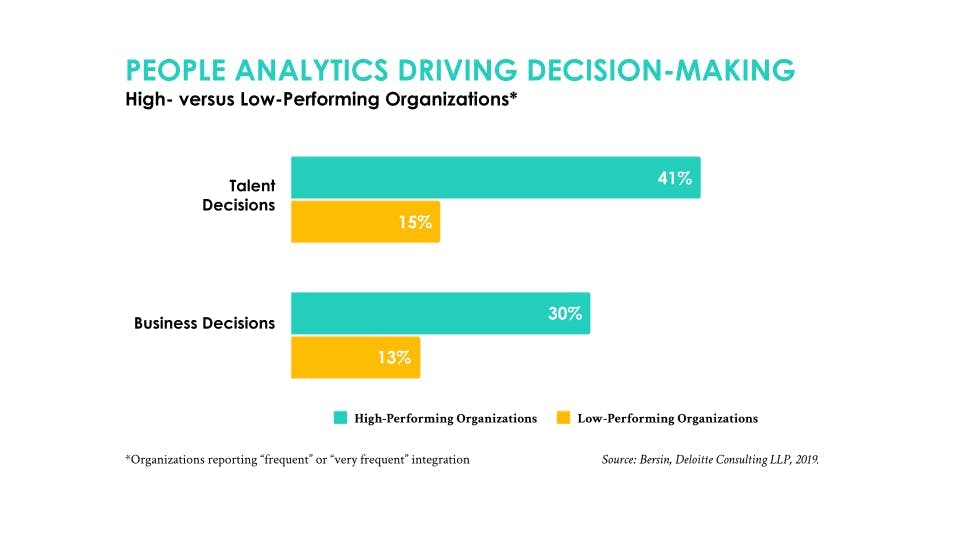
As this table from Deloitte shows, organizations benefit immensely when they use people analytics data to inform decision making.
Boost employee confidence in data usage by increasing exposure and ability to fail
When considering the significant role that employees have in shaping company culture, there are two factors to consider:
- Employees need to be exposed to data-derived insights, which will help them feel comfortable integrating data into their workday.
- Creating a safe space in which employees can fail fast, avoid overwhelm, and have good behaviors rewarded will also increase adoption of data-driven behaviors.
Let’s dive into each of these issues and their possible solutions.


behavior change 101
Fixing a lack of exposure to data-driven culture
Change breeds anxiety. Exposure to new changes will reduce worry, increase acceptance and spur adoption of the new way of doing things.
If your employees, like most of us, typically make decisions based on emotion or experience, you may encounter resistance to abandoning the status quo.
Solution 1: Increase data democratization
Data democratization occurs when data is accessible to every employee - there are no gatekeepers blocking access to the organization’s data.13
Data democratization can enhance acceptance of cultural changes by allowing all employees to improve their data analytic skills and use that information to make wise decisions.13
Of course, internal governance should be available in order to manage sensitive information. For example, each employee should be trained on data best practices, and there should be specialists in place to make sure these standards are maintained.
Managers must model their preferred type of data agility: when employees see leaders embracing data, it increases the likelihood that they will too.14 Embracing data looks like integrating it into aspects of work that it hasn’t been in previously. For example, a manager might use it to analyze applicants’ experience levels, or make writing emails more effective by tracking the subject line that leads to the most reads.
Solution 2: Communicate updated expectations and why the changes are occuring
Leaders need to communicate why changes are occurring and why they're important.15 With the goal of increasing data fluency, provide employees with the opportunity to upskill in a gradual manner: encourage courses or reading materials, stress why the skills are important and that the process isn’t expected to be immediate. Start with the easiest interventions, and update them according to the degree of receptivity of each individual employee.
Solution 3: Identify transition advocates
Managers can find assistance in employees, too. Identify people who are excited about the transition and can help their peers with the transition.
Change agents like these help build a network-like structure and create an easy way for questions to be answered.11 Executives can seek answers from employees on how to make cultural changes more digestible and approachable - involving them will ensure that adjustments are adopted more readily.16
Fixing employees’ fear of failure
On top of their typical day-to-day duties, a cultural overhaul might overwhelm employees. The feeling of being overwhelmed can lead to behaviors like:
- Confusion
- Challenges with concentration
- Forgetfulness
- Apathy
- Poor relationships with coworkers17
In addition to the above factors, a fear of failure can also lead to overwhelm given one must constantly be weary of avoiding risks or not making mistakes.
Solution: Allow employees to fail and reward positive behaviors
To alleviate employees’ root fears of failure, you can create a system that recognizes and rewards embracing the new company culture.
You can even take it a step further and encourage them to fail. Failure can help employees flourish by allowing them to identify what went wrong, learn from their mistakes, and take risks in a safe environment.
In order for this to work, leadership must facilitate opportunities for learning that are free from shame, stigma, and pressure.18 Reward those who make mistakes and learn from them.19
In addition to giving employees an opportunity to experiment and improve their data literacy skills, executives should reward positive behavior. When a task is new - like integrating data insights into daily habits - its consequences have significant ramifications for whether or not we repeat that behavior.20 Did we mess up the data interpretation and embarrass ourselves in front of our peers? Or were we applauded for our hard work?
Positive reinforcement is the addition of a satisfying stimulus in response to a behavior, and an effective way to shape in the workplace.21 Reinforcement can either be intrinsic (intangible rewards like acknowledgement or recognition) or extrinsic (a bonus or publicity).22