The traditional CX approach and its challenges
In 2022, almost 90% of C-level executives reported that the needs of their customers and employees change faster than they can adapt to those needs.1 While those numbers sound shocking, it shouldn’t come as a surprise. Larger companies comprised of many departments tend to struggle with alignment and visibility — making a cohesive CX near impossible.2
Considering behavioral science in CX
Our brains are no match for the excess of information brought to us in the digital age. Our limited processing capacity prevents us from synthesizing everything in our environment, so we rely on heuristics (or mental shortcuts) to make sense of the world. We assess value through concepts like relative comparison, or by time and effort to gratification.
This creates challenges for evaluating CX — emotions are tough to quantifiably measure. While touchpoint optimization can be beneficial in ensuring each segment works individually, it doesn’t necessarily mean the segments work well together. More importantly, touchpoint optimization doesn’t ensure positive customer perception.

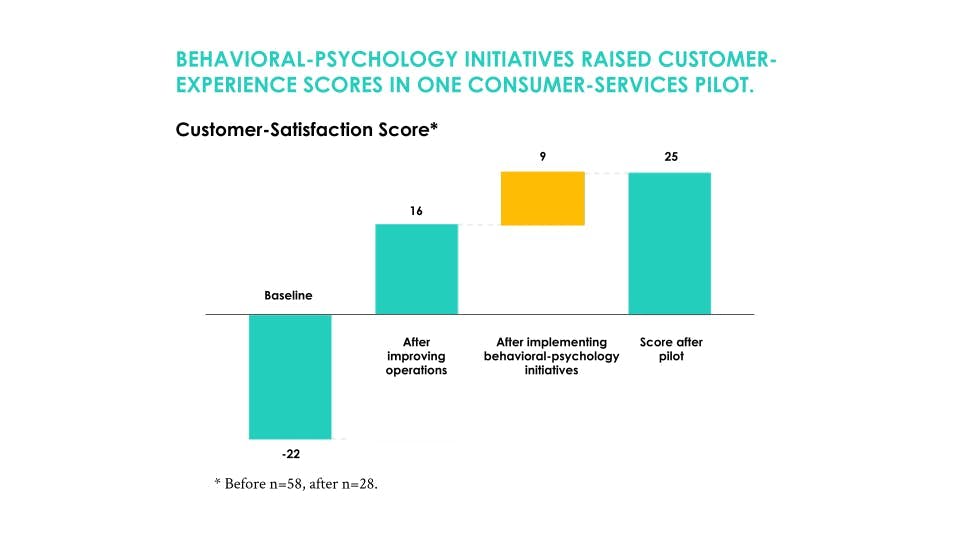
From McKinsey & Company: Implementing behavioral science initiatives improved customer experience scores more than operations initiatives.
A modern definition for CX can unlock new opportunities
A traditional understanding of CX is limited to the motions customers go through during the consumption process.
A modern, behaviorally-informed understanding encompasses customers' memory of a company, and how these memories influence their future interactions. These memories come from emotional associations at key touchpoints, and comparisons with similar experiences.3
This latter definition highlights the importance of situational factors, promoting a more realistic understanding of CX.


behavior change 101
Considering the peak-end rule approach in CX decisions
We primarily judge an experience based on two memories: how we felt at the end and the highlights. This is called the peak-end rule, and it explains why CX is dependent on the emotions associated with the experience, rather than objective customer ratings for individual parts of the experience.
Companies can leverage the peak-end rule using choice architecture — the practice of designing an environment to encourage certain outcomes. In order to make best use of the peak-end rule, negative emotions should be condensed at the beginning of the customer experience, good emotions spread throughout, and endings should feature a high note.
What the peak-end approach means for CX
- Condense negative emotions at the beginning
Condensing negative emotions at the beginning of the customer experience gets the necessary, not-always-pleasant actions out of the way as soon as possible. For example, hotels collect your payment information at check-in, so you aren’t reminded of the price-per-night that you’re dishing out for the rest of your stay. In a sequence of events that involve good and bad experiences, we tend to prefer unfavorable events come first and desirable events come at the end.
Suggestion: Condense all payment and administrative requirements into the first touchpoint
- Spread positive emotions throughout
Spreading positive emotions throughout will help customers leave with positive associations of the overall experience. For example, amusement parks don’t condense all the rides and rollercoasters into a single touchpoint — they spread out the enjoyable experiences by having customers line up to go on rides, and placing food stands, performers, and games all over the park.
Suggestions:
- When possible, check-in regularly with customers to ensure their experience is satisfactory and make real-time changes when needed
- Offer pleasant surprises throughout the experience, like freebies or rewards
- End on a high note
Ending on a high note leaves a positive final impression on the customer. Saving the best for last leverages the serial position effect — we’re wired to remember the last touchpoints first. Think of the free continental breakfast you get on the way out of the hotel in the morning.4–6
Suggestions:
- Offer a pleasant surprise at the end, such as a food stand, discounts on following purchases, rewards for joining loyalty programs or free/discounted auxiliary accessories or services
- Make the experience enjoyable even after the last touchpoint, such as making the unpackaging experience pleasant through aesthetically pleasing colors and design
- Offer souvenirs or customizations to newly-bought products near the last touchpoint
Focus on autonomous design
Self-determination theory (SDT) suggests there are 3 components to achieving psychological satisfaction:
- Autonomy: Feeling in control of our decisions.
- Competence: Feeling like we do things well, and can improve our abilities.
- Relatedness: Feeling meaningfully connected to others.
Companies can satisfy our need for autonomy and competence by giving customers control over their experience. We’re happier and more comfortable when we believe we have control over a process, especially an uncomfortable one.7
Letting customers choose details like appointment time, which cashier line to checkout at, or where to eat on a cruise gives customers autonomy over part of their experience.4,5
Suggestions:
- Let customers choose details that will affect their experience, such as:
undefinedundefinedundefinedundefined - Offer to customize products or personalize services when possible
What the behavioral approach has to offer for CX
Leveraging behavioral science strategies to improve the customer journey through autonomous design and the peak-end approach is important to consider, because it will set companies apart from others and create a positive customer experience to keep people wondering what makes your brand stand out so much.