Have you ever ordered an Uber, Instacart, or stayed at an AirBnB? Many of us interact with the gig economy on a regular basis.
There’s no doubt that having the convenience of riding in a temporary car, staying in a temporary home, or getting food delivered with the touch of a button has changed the way we live our lives.
But the dark side of the gig industry leaves huge gaps for improvement.
An increasing number of companies have begun to take advantage of the gig economy, and many (like Uber and Lyft) have built their empire on it. According to PEW, in 2021, 16% of Americans have, at some point, earned money from a gig job.1 Other estimates put that number closer to one third (36%), or approximately 57 million people.2
Despite the high numbers, gig workers aren’t often pleased with their work experience, often citing the lack of a workplace community.
How gig working can contribute to negative feelings
A gig worker is a person who works temporary jobs, usually in the service industry. Over the last few years, and especially since the pandemic, gig working has risen in popularity.
While there are many upsides, gig workers need to feel a sense of belonging in order to do their best work. Canadian gig workers report feeling increased rates of powerlessness and loneliness compared to full-time, permanent workers.3
While gig workers tend to have increased rates of financial stress, this doesn’t fully explain the emotional gap between gig and permanent workers.3 This finding is true among other groups of people, e.g. workers in African countries: increased freedom and flexibility in these gig roles doesn’t always translate to improved work conditions or livelihoods.4
There is a massive potential for growth in number of gig workers
With more people getting access to the Internet, the potential for the gig economy to expand is immense. According to the World Bank, the arrival of broadband will lead to a projected increase of millions of task-based jobs and billions of dollars of revenue.7
If the Internet penetration rate rises to 75% in all developing countries, up from its current rate of about 35%, that could add as much as USD $2 trillion in GDP and establish an additional 140 million jobs globally.7
The tangible benefits of belongingness and trust in the workplace
These insights present opportunities for firms to take advantage of the increase in available workers, and also to make changes to the way gig workers interact with their company ahead of this massive growth.
Belongingness helps facilitate longer employee tenure, as well as greater productivity and satisfaction. In fact, it’s so important to firms in the United States that $8 billion is spent each year on diversity and inclusion initiatives.8 However, even these initiatives tend to miss the mark because they don’t address our desire to feel included.8


behavior change 101

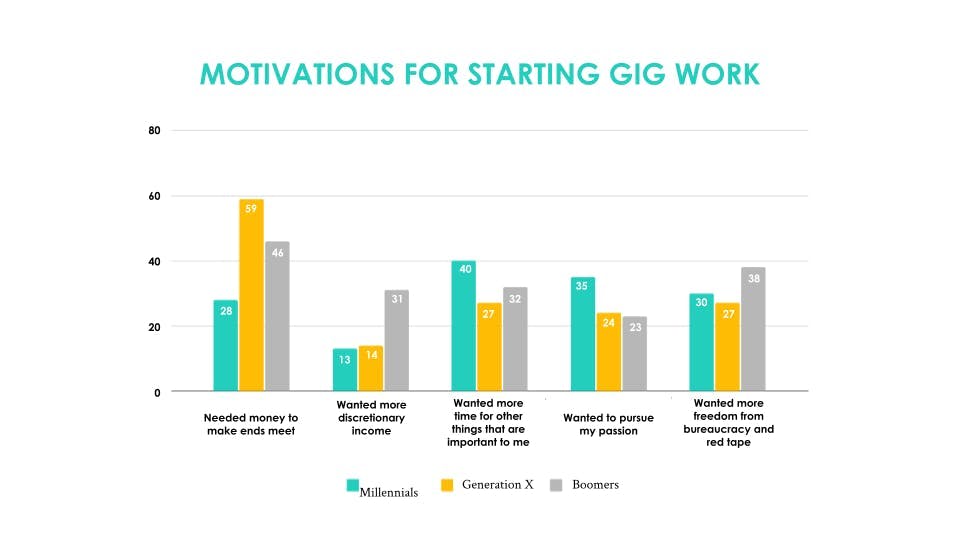
According to data from Statista, the motivations for starting gig work varies by generation.
What can gig managers do?
The problem: While we’ve established that belongingness and trust are pivotal to the positive experience of contractors, managers often prioritize permanent employee satisfaction over contractor satisfaction.
Why it happens: One reason why managers might overlook contractor happiness may be the mere-exposure effect, our tendency to prefer people we’re frequently exposed to over those we don’t see or think of as much. Since permanent employees come into the office, managers are wired to prioritize their happiness over contractors, who would rarely, if at all, visit an office.
A second explanation is the hot hand fallacy, our tendency to assume someone performing well at a task will continue to perform well on that task in the future. In the context of management, this fallacy arises upon assuming that, because contractors are performing well, they will continue to perform well regardless of any identification or addressment of their needs.
How to fix it: To address the mere exposure effect, managers can implement ways to learn more about the gig workers under their employ. Try inviting representatives to join company meetings or set aside time to get to know those who are interested in improving the gig worker experience. Increasing number of interactions between management and gig workers can help combat the mere-exposure effect.
To remedy the hot hand fallacy, we need to bring logic back into the conversation. Managers can do this by facilitating conversations among the managerial team in which the performance of gig workers is discussed realistically. While this approach may likely take more time and effort, it’s also more likely to yield greater holistic consideration towards what it is that gig workers need to maintain their output.